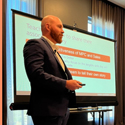
Sometimes, success in recruiting requires more than hard work, persistence, and a little bit of luck.

Matthew Deutsch
Sometimes, it requires sticking with something even when you’re not entirely sure it’s going to work.
Just ask Clint Martz of A to Z Search Group, who experienced his share of frustration during his first couple of years in Top Echelon Network. Despite making a few placements and attending Network conferences, Clint wasn’t seeing the results he had hoped for.
In fact, by October of 2024, he was seriously considering leaving the Network altogether.
Then 2025 happened.
Clint went on to enjoy his most successful year in Top Echelon Network, making approximately eight split placements and earning recognition as one of the Network’s top-producing recruiters.
Not bad for somebody who had been thinking about calling it quits!
Of course, Clint’s story isn’t simply about a difficult beginning followed by a successful year. It’s also about the importance of building relationships, finding the right trading partners, maintaining professional standards, and recognizing that recruiting success doesn’t always follow a predictable path.
And while Clint appreciates the recognition he’s received, he’s far more interested in making placements and developing relationships than collecting accolades.
According to Clint, below are four big takeaways from his experience in TE Network.
#1—Persistence Can Pay Off, Even When Success Takes Longer Than Expected
When Clint joined Top Echelon Network, he hoped that working with other recruiting professionals would help him make more placements and grow his business.
However, things didn’t exactly go according to plan.
“The first couple of years in TE were very challenging and didn’t get much help in the network,” Clint said.
That wasn’t because he wasn’t trying. Like other agency recruiters, Clint was working job orders, presenting candidates, and attempting to close deals. Unfortunately, several promising opportunities fell apart before they could become completed placements.
“I had a few offers that didn’t go through mainly because of candidates not passing their background checks or lying about their work history,” he said.
For recruiters, few things are more frustrating than getting a candidate through the hiring process, reaching the offer stage, and then watching the opportunity disappear because of an issue that could have been avoided.
And when those disappointments happen repeatedly, it’s only natural to question whether the time and effort are producing enough results.
Clint did manage to make a couple of placements during those early years. He also found value in attending Top Echelon’s conferences, where he could connect with other recruiters and develop relationships.
But the results still weren’t where he wanted them to be. By the time he attended the Network conference in October of 2024, he was having serious doubts about continuing his membership.
“I remember telling people at the conference in October 2024 that I was seriously contemplating if I wanted to stay in the network,” Clint said.
That’s a pretty significant admission, especially from somebody who would eventually become one of the Network’s more productive members. However, Clint was careful to distinguish his frustration with his results from his experience with the people at Top Echelon.
“Don’t get me wrong, the people at Top Echelon are all great and have treated me very well,” he said.
In fact, Clint had already developed a positive reputation within the organization.
“I get people that tell me that Drea referred me to them so I guess I was doing something right,” he said.
Despite his reservations, Clint decided to continue participating in the Network. And that decision would prove to be an important one.
The lesson is that split placement success doesn’t always happen immediately. Sometimes, the relationships and opportunities you’re developing take time to produce meaningful results.
For Clint, that patience eventually paid off in a big way.
#2—The Right Trading Partner Relationships Can Change Everything
After a challenging start in Top Echelon Network, Clint experienced a dramatic turnaround in 2025. The difference? Relationships.
“Then 2025 happened,” Clint said. “2025 was my biggest year in TE doing 8 splits I believe and my best year since joining the network.”
That’s quite a change from the previous October, when he had been seriously considering whether Network membership was worth continuing. And Clint credits much of that success to the recruiting relationships he had begun developing.
“I really started to develop some good relationships with key TE Recruiters that I have been leaning on and the results showed,” he said.
This is an important point because successful split placements are rarely the result of simply posting a job order and waiting for candidates to appear. They often require recruiters to identify compatible trading partners, establish trust, communicate expectations, and develop a productive working relationship.
Once those relationships are established, they can create opportunities for repeated collaboration. And that’s what Clint began experiencing in 2025.
His increased production also earned him recognition from Top Echelon. According to Clint, he was recognized as one of approximately the top five or six recruiters in the Network for the year. But while he appreciates being acknowledged for his accomplishments, individual recognition isn’t what motivates him.
“I am humbled with all the recognition but truly just want to make placements and continue building relationships,” Clint said.
That attitude says a great deal about how he approaches his recruiting business.
For Clint, the value of the Network isn’t measured by awards or rankings. It’s measured by the opportunities to collaborate with other recruiters and turn those collaborations into completed placements.
And while 2025 represented a breakthrough, Clint also understands that success in recruiting can be unpredictable. The following year has brought a different set of challenges.
“This year has been a little bit of a different story and not as successful as last year,” he said.
At the time he shared his experience, Clint reported five placements for the year, although two had not yet been completed in the Network’s records because payment had not been received. One of those placements was also his largest to date.
However, some of the trading partners who helped him achieve his success in 2025 haven’t generated the same level of activity this year. That’s the nature of recruiting. Job orders change. Candidate availability fluctuates. Client needs evolve. And even productive partnerships can experience slower periods.
But Clint has also discovered a promising new trading partner relationship.
“One partner who has really helped me out this year is Lisa Vella-Puff,” he said. “We have already done 2 splits and are in the final stages of another. I can see us having a great partnership moving forward.”
That’s exactly the kind of relationship that can make Top Echelon Network valuable over the long term.
A successful trading partnership isn’t necessarily about making one placement. It’s about establishing a relationship that can produce opportunities again and again.
And as Clint’s experience demonstrates, continuing to develop new relationships is important even after you’ve established productive ones.
#3—Communication, Accountability, and Respect Build Strong Partnerships
Of course, building successful recruiting relationships requires more than finding somebody who can provide candidates. It also requires being the kind of trading partner other recruiters want to work with. And Clint takes that responsibility seriously.
Having spent many years in the recruiting profession, he understands how frustrating it can be when communication breaks down, job orders aren’t updated, or recruiters are left wondering what’s happening with their candidates. That’s why he makes a point of communicating consistently and respecting the time of his trading partners.

Clint Martz
“I am very good at keeping people up to date on candidates and I don’t ‘ghost’ people and always keep postings up to date,” Clint said.
That might sound like a basic expectation, but experienced recruiters know that consistent communication isn’t always a given.
- A candidate gets submitted, and then nothing happens.
- A client changes the requirements, but nobody communicates the changes.
- A position gets filled or placed on hold, yet the job posting remains active.
These situations waste time, create frustration, and can damage relationships between recruiters. Clint makes an effort to avoid those problems.
“I have been doing this a long time and don’t want to waste people’s time,” he said.
That philosophy also influences how he distributes job orders within the Network. Rather than posting every available position to the entire membership, Clint sometimes prefers to work directly with recruiters who have already demonstrated that they can deliver results.
“I don’t post all my positions in TE and I am one who gives people exclusives on openings if I had success with them in the past,” he said.
That’s an interesting approach, and it reinforces the value of developing trusted trading partner relationships. When a recruiter has already demonstrated an ability to identify qualified candidates, communicate effectively, and collaborate professionally, there’s a natural incentive to work with that person again.
And offering an exclusive opportunity can be one way to strengthen that relationship. Of course, that doesn’t mean Clint isn’t interested in developing additional partnerships. His recent success with Lisa Vella-Puff demonstrates that he’s continuing to connect with other members who can help him fill positions.
But he also recognizes the importance of rewarding productive relationships and working with people who understand his expectations.
Ultimately, strong split placement partnerships are built on trust, consistency, and mutual respect.
Recruiters need to know that their trading partners will keep them informed, treat their candidates professionally, and communicate honestly about the status of searches. Clint understands those expectations because he has spent years working in an industry where relationships can make or break a deal.
And he intends to continue operating that way.
#4—There’s Always Room to Expand Your Network Opportunities
Throughout his membership in Top Echelon Network, Clint has primarily participated as an importer.
In other words, he’s typically been the recruiter bringing job orders into the Network and working with other members who help him find qualified candidates. That approach has produced meaningful results, particularly during his breakthrough year in 2025. But Clint also recognizes that there may be additional opportunities he hasn’t fully explored.
“I have always been considered an ‘importer’ and haven’t really had time to explore the other side or help other people out but maybe that is something I need to do more of,” he said.
That’s an important observation. Top Echelon Network is a split placement network and sourcing marketplace for recruiting agencies, meaning members can benefit from both sides of a split placement transaction.
They can share job orders and collaborate with recruiters who provide candidates. They can also source candidates for positions shared by other members.
For Clint, most of his activity has involved the first approach, and there’s a practical reason for that.
“I just have been busy with my own jobs and struggling this year to find candidates,” he said.
That’s a familiar challenge for many agency recruiters. When you’re managing your own clients, working active searches, and trying to fill difficult positions, finding time to pursue additional opportunities can be challenging.
However, Clint’s willingness to consider working on the other side of the Network suggests that he’s still looking for ways to expand his involvement. And that willingness to adapt is especially important in a profession where business conditions can change quickly.
One year might bring a surge in placements. Another might require more effort to find qualified candidates or develop new trading partner relationships. The key is recognizing that there are different ways to create opportunities.
For some recruiters, that means sharing more job orders. For others, it means sourcing candidates for their trading partners. And for still others, it means developing a combination of both approaches.
Clint hasn’t yet made that transition, but he’s open to the possibility. And despite the ups and downs he’s experienced, his overall assessment of Top Echelon Network remains positive.
“As far as my overall experience with TE, it has been positive,” he said.
He also doesn’t hesitate to recommend membership to other recruiting professionals.
“I would highly recommend someone to TE and look forward to developing more relationships with people in the network to help me with my searches,” Clint said.
That’s a significant endorsement coming from somebody who once seriously questioned whether he should remain a member. Clint knows firsthand that membership doesn’t guarantee immediate success. He’s experienced disappointing deals, difficult years, and trading partner relationships that haven’t always produced consistent results.
But he’s also experienced the other side of the equation. He’s seen what can happen when the right recruiters work together, communicate effectively, and develop productive relationships.
And those experiences have convinced him that the Network continues to offer opportunities worth pursuing.
From Almost Leaving to Becoming a Top Producer
In October of 2024, Clint Martz attended a Top Echelon Network conference with a serious question on his mind. Should he stay, or should he go?
His first couple of years hadn’t produced the results he wanted. Several promising offers had fallen apart. And although he appreciated the people at Top Echelon and enjoyed attending the conferences, he wasn’t convinced that membership was delivering enough value.
Then came 2025. By developing stronger relationships with key trading partners, Clint enjoyed his most successful year in the Network, making approximately eight split placements and earning recognition among its leading producers.
That’s quite a turnaround. And while the following year has presented additional challenges, Clint has continued making placements, including his largest placement to date, while developing a promising partnership with Lisa Vella-Puff.
His story reinforces several important lessons for agency recruiters.
Success doesn’t always happen immediately. Productive trading partner relationships take time to develop. Communication and professionalism matter. And even after a breakthrough year, recruiters need to continue building relationships and looking for new opportunities.
Perhaps most importantly, Clint’s experience demonstrates that a difficult beginning doesn’t necessarily determine the long-term value of a business relationship.
Sometimes, you have to work through the frustrating periods before you discover what an opportunity can become. Of course, that doesn’t mean every year will be a record year. Clint knows that better than most.
But he also knows that having access to other recruiting professionals can make a meaningful difference when the right relationships come together. And that’s why he continues to participate in Top Echelon Network.
He’s not particularly interested in awards or rankings. He doesn’t need the spotlight, and he’s certainly not interested in wasting anybody’s time. He simply wants to make placements, serve his clients, and build lasting relationships with recruiters who share his commitment to doing business the right way.
For Clint Martz, that’s what success in Top Echelon Network is all about.
And considering how close he came to leaving before his breakthrough year, it’s a good thing he decided to stick around.